Skip to content

Responsible & Ethical Use of Generative AI in Academics

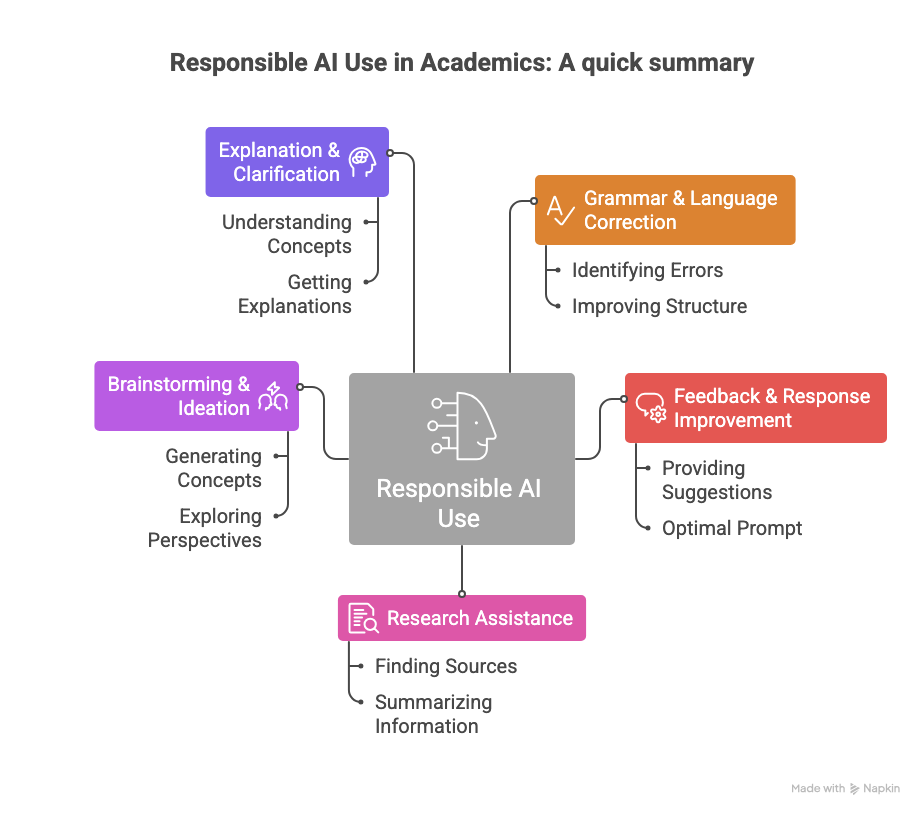
Artificial Intelligence (AI), especially Generative AI (Gen AI), is transforming education and learning. Tools such as ChatGPT, Claude, Gemini, Perplexity, Canva AI, and other AI-powered platforms can support learning, improve communication, and help healthcare professionals understand complex concepts.

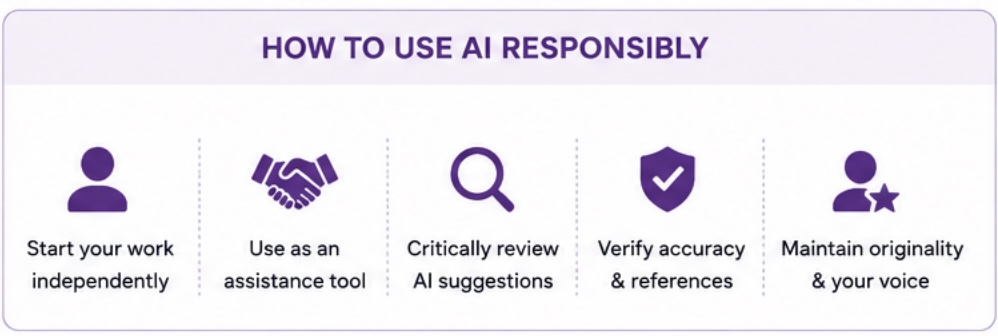
At NIMHANS Digital Academy, learners are encouraged to use AI responsibly, ethically, and transparently as an assistance tool — not as a replacement for original thinking, clinical judgment, or analytical ability.

This guidance has been prepared after reviewing educational and academic AI policies from universities and publication platforms, as well as practical experience with AI tools in healthcare education.
Effective Prompts to AI for better response

👨‍⚕️
Example Prompt – Medical Doctor

Responsible AI Prompting Example

“I have enrolled in the NIMHANS course/module on Addiction Management. This is an essay response for the management of a 42-year-old patient having an alcohol withdrawal seizure. Please review my draft, keeping in mind that I am a clinician.”

👩‍⚕️
Example Prompt – Nurse Counsellor

Responsible AI Prompting Example

“I work as a nurse cum counsellor in a TB clinic. Can you provide evidence of Brief Intervention for smoking cessation among patients with Tuberculosis? Please provide references from peer-reviewed journals.”

🧑‍🏫
Example Prompt – Counsellor

Responsible AI Prompting Example

“Act as a counsellor who is developing awareness content on cannabis use for 12th standard college students.”

📊
Example Prompt – Researcher

Responsible AI Prompting Example

“I am a researcher comparing the mean age of two groups. Which statistical test is appropriate when the sample size of each group is below 50?”

Please avoid 

The following uses of Artificial Intelligence (AI) are not advisable for NIMHANS academic courses or training:

  • Complete content generation without learner contribution
  • Dumping assignment or examination questions directly into AI tools
  • Submitting fully AI-generated work as original work
  • Excessive dependence on AI-generated responses
  • Using AI to bypass academic or professional learning requirements
  • Presenting AI-generated responses without proper review or validation

AI Content Limit: The maximum AI-generated contribution should not exceed 20% of any submission as per AI detector

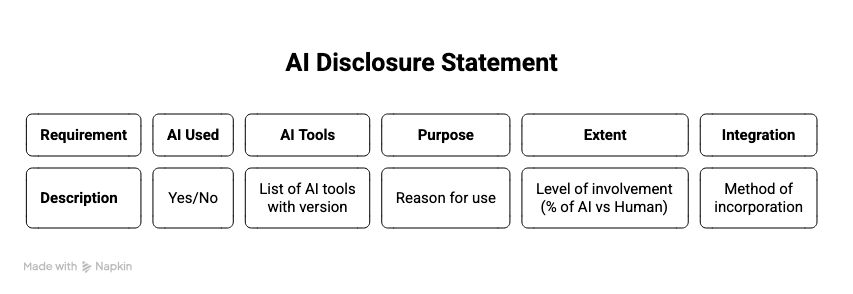
All submissions must include an AI Disclosure Statement that specifies: Whether AI was used || Which AI tools were used || Purpose of AI usage || Extent of AI usage || How AI was integrated

Drafted on: 22 May 2026 (This is a fast-changing field; this page will be updated in due course.) Claude AI assisted in drafting and refining the content; Napkin AI was used for image generation; Grammarly was used for grammar correction. Content reviewed and approved by the Centre for Addiction Medicine, NIMHANS