Skip to content

AI in Addiction & Mental Health

Understanding How Artificial Intelligence Supports Modern Mental Healthcare

Addiction and mental health conditions are complex, chronic, and often relapsing disorders requiring long-term monitoring and personalized interventions. Artificial Intelligence (AI) and Digital Health technologies are emerging as critical tools to address these gaps, moving care from reactive treatment to proactive support.

Why AI Matters Today

Addressing the rising prevalence, high relapse risks, and limited access to specialist care.

  • Early Risk Identification
  • Personalized Interventions
  • Continuous Care Continuity
  • Evidence-Based Support

Key AI Technologies

Machine Learning (ML)

Teaching computers to learn from examples instead of programming them with explicit rules. Instead of telling a computer “if temperature >38°C, then fever,” we show it thousands of patient records and let it figure out the patterns itself.

In clinical cases: Machine learning involves feeding a computer thousands of clinical notes and allowing it to discover patterns that might be missed, such as which combinations of symptoms predict relapse more effectively than any single factor.

Level 1: Simple Explanation

You show the computer 10,000 photos labeled “cat” and 10,000 labeled “not cat.” Eventually, it figures out: pointy ears + whiskers + four legs = probably cat. Now it can identify cats in new photos it’s never seen.

Level 2: Medical Colleague Explanation

Instead of coding rules manually, we provide labeled data (like 6,500 clinical notes with annotations) and let algorithms find mathematical patterns. The computer creates a model—essentially a complex equation—that maps inputs (clinical notes) to outputs (substance use categories).

Level 3: Technical Explanation

Machine learning algorithms adjust millions of parameters through iterative training to minimize prediction error. In our case, we used supervised learning: the model sees a clinical note, makes a prediction about substance use, gets corrected, and adjusts its internal weights until predictions become accurate.

Large Language Models (LLM)

Large Language Models (LLMs) are a class of Artificial Intelligence (AI) systems built to generate, understand and modify human language by learning patterns from large data sets.

What is a Token?

A token is the basic unit of text that AI language models process—think of it as the model’s equivalent of a ‘word,’ though not exactly the same. Tokenizers break text into these discrete elements, which may be whole words, parts of words, or even individual characters.

Example: “pharmacotherapy” might be split as:

  • 1 token: “pharmacotherapy” (whole word)
  • 2 tokens: “pharmaco” + “therapy”
  • 3 tokens: “pharma” + “co” + “therapy”

Or even smaller fragments.

Example: “buprenorphine” might be split as:

  • 1 token: “buprenorphine” (whole word)
  • 2 tokens: “bup” + “renorphine”
  • 3 tokens: “bu” + “pren” + “orphine”

Or even smaller fragments.

This chunking strategy allows models to:

  • Handle rare medical terms or technical vocabulary efficiently
  • Process text in any language
  • Capture meaning across long clinical narratives
  • Understand context and relationships between concepts

Tokens also include spaces, punctuation, and special markers like “<EOS>” (end of sequence). Importantly, the model never sees actual words or letters—only these tokenized sequences. This is why token limits matter: a 4,000-token context window might hold roughly 3,000 words of clinical text, but complex medical terminology may consume more tokens per word.

Level 1: Simple Explanation

The computer read millions of books, websites, and conversations. Now when you start a sentence, it can guess what comes next because it’s seen similar sentences before. String enough predictions together, and you get coherent text.

Level 2: Medical Colleague Explanation

LLMs are trained on trillions of words to predict the next token (word/part of word) in a sequence. Through this simple task, they learn grammar, facts, reasoning patterns, and even some common sense. GPT-4 has 1.8 trillion parameters—essentially 1.8 trillion knobs that got tuned during training to make better predictions.

Level 3: Technical Explanation

LLMs use transformer architecture with self-attention mechanisms to process text. During training (on ~13 trillion tokens for GPT-4), the model learns to represent words as high-dimensional vectors and predict next-word probabilities. What emerges are “emergent abilities”—capabilities like reasoning and instruction-following that weren’t explicitly programmed.

Key Capabilities

Understanding clinical notes and extracting information
Generating coherent text and summaries
Conversing in ways that feel human-like

How Do LLMs Work?

A Brief Overview for Clinicians

1. The Mechanics: Self-Attention & Training

Self-attention allows the model to weigh different parts of an input and determine which words are most relevant in predicting the next token. LLMs are trained on vast amounts of text from books, websites, articles, and dialogue through unsupervised learning—meaning they learn by predicting missing or next tokens in sequences. Training involves adjusting billions of parameters through an iterative process to minimize predictive error. With sufficient exposure to human language, LLMs develop implicit knowledge of grammar, syntax, semantics, and even abstract reasoning, enabling them to generate contextually relevant outputs across diverse tasks without task-specific training.

2. Evolution & Emergent Abilities (Brief GPT History)

The evolution from GPT-1 (2018) to current models like GPT-4, Claude, and Gemini demonstrates how scale enables capability. Early models required explicit fine-tuning for each task, but later generations developed ’emergent abilities’—complex skills like reasoning, planning, and following natural language commands—that appeared when models exceeded certain size thresholds. This allows modern LLMs to function as general-purpose problem solvers rather than simple text predictors.

3. Safety Alignment & Clinical Relevance

Beyond initial training, LLMs undergo instruction tuning (learning to follow commands) and reinforcement learning from human feedback (RLHF), where human raters evaluate outputs for helpfulness, safety, and appropriate tone. This process helps models become more empathetic, supportive, and clinically appropriate—especially important when discussing sensitive topics like addiction and mental health.

Where AI is Used

Decision Support

Clinical decision support systems helping professionals make consistent choices.

Risk Assessment

Predicting relapse risk and checking for signs of deterioration.

Digital Therapeutics

Apps and tools for behavior change and self-monitoring.

Remote Care

Tele-mental health support and outcome monitoring dashboards.

Benefits of AI-Enabled Care

  • Earlier identification of risk and deterioration
  • More personalized treatment planning
  • Better continuity of care between visits
  • Improved monitoring of outcomes
  • Scalable support in resource-limited settings

Limitations & Responsible Use

AI acts as a support to trained mental health professionals, not a substitute.

  • AI outputs depend on the quality of data
  • Potential for bias in algorithms
  • Predictions are probabilistic, not certainties
  • Clinical judgment remains essential

Our Approach at VKN NIMHANS

We explore AI and Digital Health tools with a strict focus on safety and efficacy.

Clinical Relevance || Ethical Use || Evidence-Based || Transparency

Acknowledgement

Dr Lekhansh Shukla, Dr Aishwariya Jha, Dr Prakrithi Shivaprakash and Heads AI team

Learn More

Explore related resources and initiatives on this platform.

Frequently asked questions

Most frequent questions and answers

What is Generative AI

AI that can create new content, text, images, audio and videos, etc. It also acts like digital assistance to help with writing, summarising, and designing. 


What is Prompt and Prompt Engineering

Prompt is the text input (question and instruction) that we give to Gen AI tool.

  • Craft clear instructions : Avoid vague instruction 
  • The way we ask determines the response: Save time 
  • Works best when given context, role and constraints : Makes more reliable

How Gen AI works

  • Learns the pattern: Studies massive datasets to understand language, images and content structures. 
  • Predicts Sequence: Determines what should come next in words  or creative elements
  • Creates Content: Generate human-like texts, images, audio and videos from simple prompts.

What is Natural Language Processiong (NLP)?

Computers are good at math but now we need them to learn language. Natural language processing (NLP) refers to computational methods that allow machines to extract meaning and structure from human language — clinical notes, transcripts, speech, or patient-generated text or social media post etc — by converting words into numerical representations that models can analyse for patterns.

Why Generative AI Matters Today?

  1. Accessibility Revolution: Free user-friendly platform available for everyone
  2. Creative Possibilities: Generate stories, images, videos and professional content easily
  3. Education impact: Help in creating lessons, assessments 

What is Machine learning (ML)

Machine learning (ML) is a subset of AI that enables systems/programs to learn from experience, patterns, etc., in the data rather than requiring a human to write step-by-step rules for every single task. You give computer thousand of examples and correct answers. The computer figures out rules and patterns on its own (without human teaching, like a recipe).

Algorithms such as Logistic Regression, Random Forests,XGBoost (eXtreme Gradient Boosting), and Support Vector Machines (SVMs) have been widely applied in psychiatry to predict treatment outcomes, relapse risk, and diagnostic classification based on clinical and neuroimaging data

What is AI? (Artificial Intelligence)

AI is the overarching field concerned with creating programme/system capable of performing tasks that typically require human intelligence, such as perception, reasoning, problem-solving, and decision-making. By using AI, computers and software can perform tasks that normally require human reasoning: learning through experience, pattern recognition, decision-making, and problem-solving. This is in contrast to traditional learning, where the rules are set beforehand.
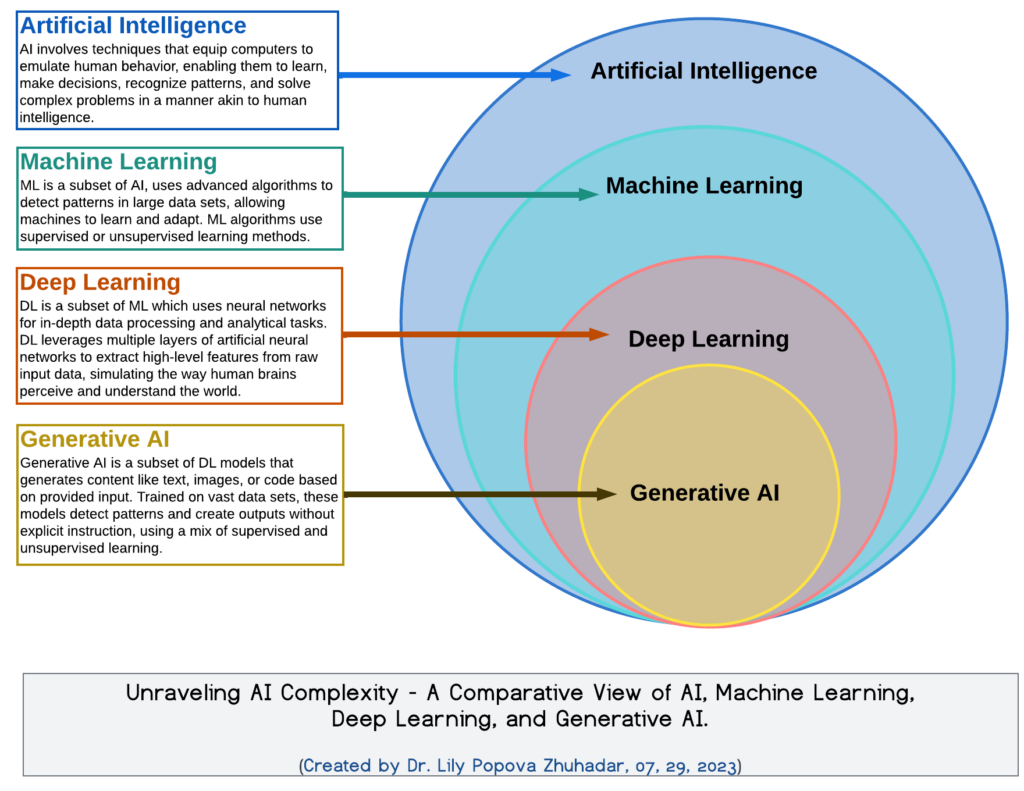
As we progress, the machine gets more and more autonomy. It also increases in generality and decreases in interpretability. Even machine is written by Human.
AI and Substance Use (click above image)

Stay Updated on AI & Mental Health

Receive curated articles, research highlights, and updates related to AI and mental health.

Updates are shared once every two months.

Responsible AI Popup
✨ Academic Integrity

Responsible Use of Generative AI

AI should support learning — not replace original thinking, academic integrity, or clinical judgment.

Maximum AI Contribution

Up to 20% of submissions with proper disclosure wherever applicable.

✓ DO

Review drafts, improve clarity, and understand concepts.

✕ DON'T

Submit fully AI-generated work or bypass genuine learning.

Read Responsible AI Policy