Certificate Course on Psychosocial Management of Substance Use Disorders
Centre for Addiction Medicine, NIMHANS · Department of Psychiatry
August – November 2026 · Every Wednesday 2:30 – 4:00 PM IST
iECHO + eLearn
Residents
completers
Why This Course?
Substance use disorders are among the most common conditions encountered in psychiatric practice and require the integration of evidence-based psychosocial interventions alongside pharmacological treatment. Despite their importance, psychiatry residents often have limited opportunities for structured training and supervised practice.
This certificate course strengthens psychiatry residents' knowledge, skills, and clinical confidence through structured learning, expert mentorship, and case-based discussions focused on real-world challenges in addiction treatment.
Course Focus
- Evidence-based psychosocial management of SUD
- Strategies to support behaviour change & recovery
- Drawn from contemporary research & clinical evidence
- Recovery-oriented, interdisciplinary practice
- Real-world case-based mentorship
Course Goals & Learning Outcomes
On completion, participants will be able to:
Psychosocial Assessment
Assess psychosocial factors that influence the development, treatment, and recovery of substance use disorders.
Motivational Interviewing
Apply MI techniques to enhance motivation and facilitate behaviour change in patients.
Relapse Prevention
Implement strategies to address cravings, triggers, and high-risk situations effectively.
Integrated Approaches
Incorporate mindfulness-based, trauma-informed, and other common approaches into addiction treatment.
Family & Group Engagement
Engage families, groups, and self-help networks to support recovery and improve treatment outcomes.
VKN NIMHANS ECHO: Hub & Spoke
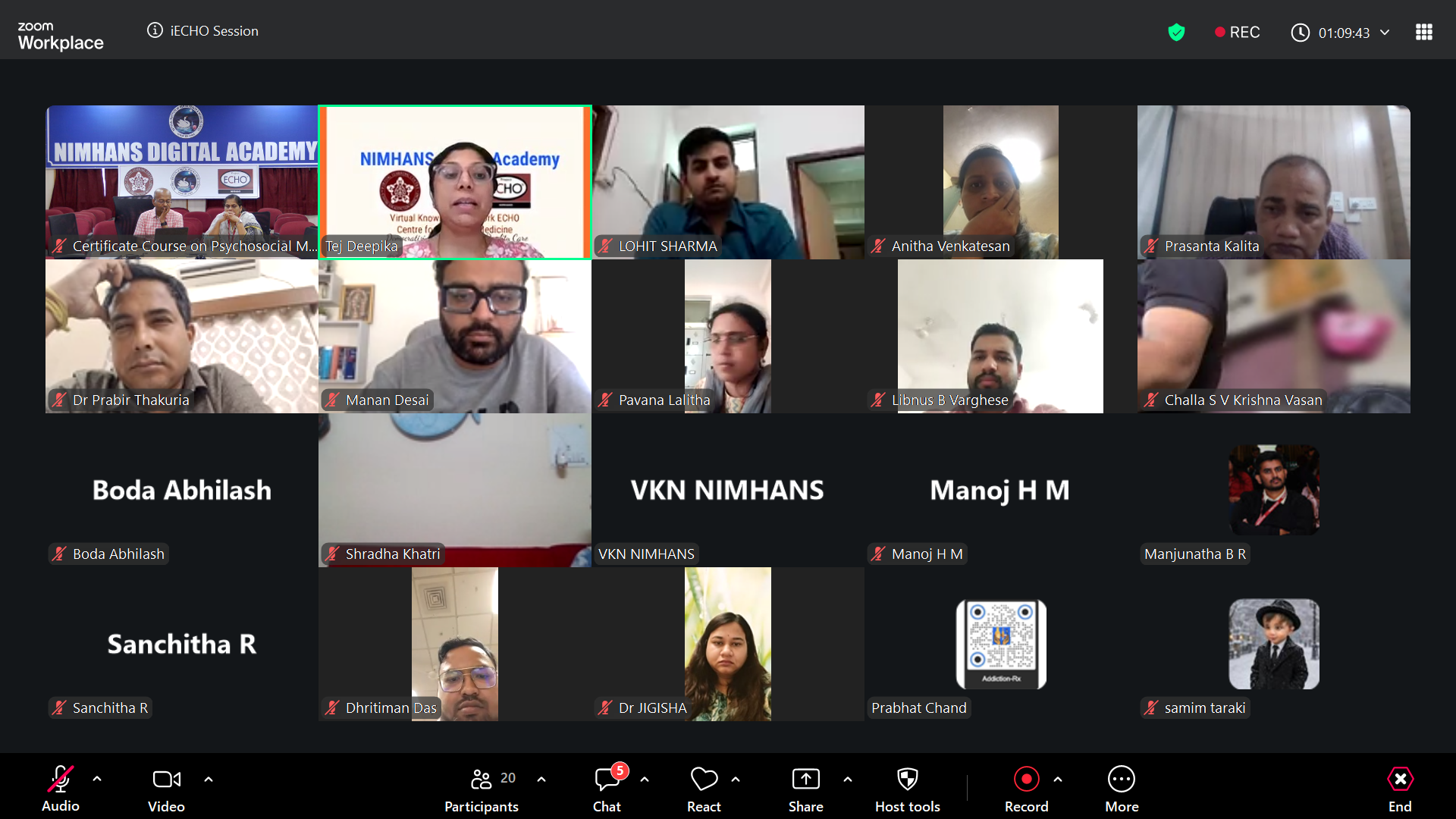
NIMHANS Digital Academy Virtual Knowledge Network (VKN) and Project ECHO operate on the Hub-and-Spoke principle — a knowledge-sharing network led by an expert multidisciplinary team at NIMHANS, using weekly multipoint video conferencing for tele-ECHO sessions.
During weekly sessions, participants present cases and seek clarification on standard management from the NIMHANS Hub specialist team and peers. This "guided practice" strengthens confidence and enhances skills — and patients receive the best treatment in their own community.
Who Are We?
Greetings from the VKN Centre for Addiction Medicine, NIMHANS, and the Department of Addiction Medicine.
Learning Modules
Three progressive modules across 12 weekly sessions, anchored in real-life case-based learning.
Motivational Interviewing in Substance Use Disorders
Sessions 1–5 · 5 Aug – 2 Sep 2026
Objectives
- Describe psychosocial factors influencing substance use disorders and recovery
- Assess readiness for change using the Stages of Change model
- Apply the spirit and core principles of Motivational Interviewing (MI) in practice
- Demonstrate key MI skills — engagement, reflective listening, eliciting change talk
- Utilize practical MI tools and techniques to enhance treatment engagement
- Evaluate the role and effectiveness of MI in managing substance use disorders
Cognitive Behavioural Therapy & Relapse Prevention
Sessions 6–8 · 9 Sep – 23 Sep 2026
Objectives
- Identify common relapse triggers, cravings, and maladaptive thoughts associated with substance use
- Implement evidence-based relapse prevention strategies to manage high-risk situations
- Formulate individualised relapse prevention plans for patients with substance use disorders
Other Psychosocial Interventions in Addiction Treatment
Sessions 9–12 · 30 Sep – 21 Oct 2026
Objectives
- Apply mindfulness-based strategies to support recovery and relapse prevention
- Incorporate trauma-informed principles into assessment and management of substance use disorders
- Engage families as partners in treatment and recovery
- Facilitate group-based interventions and link patients with self-help and mutual-support groups
Session-by-Session Programme
Every Wednesday, 2:30 – 4:00 PM IST on iECHO / Zoom · 2 case presentations per session
| Date | Didactic Topic | Speaker | Case Facilitator |
|---|---|---|---|
| 📘 Module I — Motivational Interviewing in Substance Use Disorders | |||
| 5 Aug 2026 | Introduction · Psychosocial Factors in Addictive Disorders | Dr Shreedevi & Hub Team · Dr Prabhat Chand | — |
| 12 Aug 2026 | Spirit and Skills of MI Case presenter: Dr Manan Kirankumar Desai |
Dr Aishwariya Jha | Dr Prabhat · Ms Tejdeepika |
| 19 Aug 2026 | Processes of MI with Change Talk Case presenters: Dr Prasanta Kalita · Dr Libnus B Varghese |
Ms Tejdeepika / Dr Prabhat | Dr Shivam |
| 26 Aug 2026 | Implementation: Converting to a Plan Case presenters: Dr Prabir Thakuria · Dr Dhritiman Das |
Dr Aishwariya Jha | Dr Sreya |
| 2 Sep 2026 | Case-Based Discussion Case presenter: Dr Lohit Sharma |
— | Dr Babli |
| 2 Sep 2026 | 📋 Assignment I — Live Online | ||
| 📗 Module II — Cognitive Behavioural Therapy & Relapse Prevention | |||
| 9 Sep 2026 | Relapse Prevention Therapy I: Understanding & Assessment of
Relapse Case presenter: Dr Shradha Khatri |
Dr Shreedevi | Dr Babli |
| 16 Sep 2026 | Relapse Prevention Plan & Implementation Common triggers, craving, thoughts, high-risk situations Case presenter: Dr Akin Kumar |
Mr Daniel Selva | Dr Sreya |
| 23 Sep 2026 | Case-Based Discussion Case presenter: Dr Challa S V Krishna Vasan |
— | Dr Rajamani |
| 23 Sep 2026 | 📋 Assignment II — Live Online | ||
| 📙 Module III — Other Psychosocial Interventions in Addiction Treatment | |||
| 30 Sep 2026 | Mindfulness-Based Approach to Addiction Treatment Case presenters: Dr Boda Abhilash · Dr G Subhash |
Dr Krishnan Sivasubramoney | Dr Astut |
| 7 Oct 2026 | Trauma-Informed Approach Case presenter: Dr Jigisha Das |
Ms Ishita Rath | Dr Parul Saxena |
| 14 Oct 2026 | Family-Level Interventions Case presenters: Dr Malla Pavana Lalitha · Dr Mohd Aman Naqvi |
Dr Renjith Pillai | Dr Rajamani |
| 21 Oct 2026 | Group-Level Interventions Case presenters: Dr Krutika Jagdish Mundra · Dr Anitha V · Dr Mohammad Gul Samim |
Dr Sojan | — |
| 21 Oct 2026 | 📋 Assignment III — Live Online | ||
Eligibility & Enrolment Process
Who Can Apply
- Practicing Psychiatrists
- MD / DPM / DNB Psychiatry Residents (completed or ongoing)
- Preferably completed the Primer on Motivational Interviewing and Relapse Prevention at nimhanselearning.org
Course Design
- Live ECHO: Weekly Wednesday 2:30–4:00 PM on HIPAA-compliant Zoom + iECHO.org
- Self-paced e-learning: 6 hours via elearn.vknnimhans.in or NIMHANS eLearn app
- Content accessible throughout the programme and the following year
Enrolment Flow
Submit Case
Complete a HIPAA-compliant EHR case intake form once enrolment opens
Case Quality Review
Case content quality is the criterion for invitation (AI-assisted screening)
Invitation & Fee
Nominal fee of ₹3,500 to Director NIMHANS, requested only after selection
Priority Access
Priority given to those who've completed Primer MI & RP courses
Accreditation Criteria
Approved by the NIMHANS Digital Academy Board of Studies. All criteria must be fulfilled.
📋 Eligibility for Accreditation
- Attendance: >75% (9/12 sessions) with >60 min video presence per session, as measured by software
- Case Presentation: Submit and present one patient case on psychosocial management of SUD; evaluated by the VKN ECHO team with a cut-off score of >75%
- Three e-Assignments: Proctored during live sessions; score >75% each. A second attempt is allowed only after the first attempt is completed
- Monthly Reports: Patients seen, from August 2026 through January 2027
- Pre-test & Post-test: Both must be completed
Recognition & Benefits
✅ What You'll Gain
- Build skills in evidence-based psychosocial management of substance use disorders
- Apply Motivational Interviewing, relapse prevention, and other psychosocial interventions in clinical practice
- Learn from experts and join a collaborative addiction-care network
- Enhance patient-centred care through real-world case discussions and mentorship
- Receive a Certificate of Completion upon meeting programme requirements
ℹ️ Conflict of Interest & Declaration
- No financial compensation is provided to NIMHANS faculty or invited case discussants — only a certificate of appreciation and a planner/diary
- Nominal fees collected are used solely to strengthen NIMHANS ECHO's technological infrastructure, including eLearning and Addiction Rx
- Partly supported by Odisha Digital Academy for Mental Health and Project ECHO
Digital Platforms
Core Hub Team
Chief Coordinator
Psychologist, Odisha Project
Recognition
This Certificate Course is approved by the NIMHANS Digital Academy Board of Studies, designed to build sustainable, patient-centred capacity in the psychosocial management of substance use disorders among psychiatry trainees and practitioners.
Supported by: NIMHANS · Centre for Addiction Medicine · Odisha Digital Academy for Mental Health · Project ECHO